Every year, the Fondation Simone et Cino Del Duca awards a Grand Prix d'archéologie, on the recommendation of the Académie des Inscriptions et Belles-Lettres, to help promote French archaeology in France and abroad. This year, the prestigious prize was awarded to the ADRIBOATS archaeological mission led by Giulia Boetto, CNRS Research Director and Director of the Centre Camille Jullian (CCJ, UMR 7299, CNRS / Aix-Marseille Université / Ministère de la Culture / Inrap).
Giulia Boetto is an archaeologist specializing in ancient naval architecture. A graduate in classical archaeology from the University of Turin, she worked for the Italian Ministry of Culture before being appointed, in 1997, to monitor the European Navis I and Navis II projects on behalf of the Fiumicino Ship Museum and the Ostia Archaeological Superintendency (Rome). In 2004, she took over responsibility for the study of wrecks discovered in the ancient port of Naples: "Metropolitana di Napoli - Stazione Piazza Municipio: porto antico di Neapolis". After a doctorate in Letters and Humanities at the University of Provence on the ships of Fiumicino (Italy), she joined the CNRS at the Centre Camille Jullian in Aix-en-Provence. She became deputy director in 2016, and since 2020, director. She is also responsible for a teaching unit in the Master's program on maritime and coastal archaeology (MoMArch) at the University of Aix-Marseille.
Giulia Boetto studies the typology and function of ancient ships through archaeological, iconographic and experimental sources. She is also interested in the development of photogrammetric techniques for the study, reconstruction and 3D modeling of ancient shipwrecks. She has been coordinating the Adriboats program since 2007. Co-funded by the French Ministry of Europe and Foreign Affairs, Research is conducted with Croatian partners: the University of Zadar, the Archaeological Museum of Istria and the Croatian Conservation Institute.
The work carried out as part of the ADRIBOATS program has uncovered the remains of fifteen assembled plank and monoxyle boats, dated between the Late Bronze Age and Late Antiquity, in Dalmatia, Istria and the Kupa River in mainland Croatia. Their study has provided previously unpublished data on the ancient ships that plied the coasts of the eastern Adriatic and the Danube watershed. Analysis of the architectural, technical and functional characteristics of these vessels has already revealed the vitality of local building traditions, some of which date back to pre-Roman times, and has enabled us to follow their evolution and transformation in imperial times. A case in point is the exceptional Zambratija shipwreck, dated from the late 12th to the late 10th century BC. Discovered in Istria, the wreck is the oldest example of a fully sewn ship in the Mediterranean. It provides archaeological evidence of a highly localized indigenous shipbuilding tradition that would endure for several centuries.
In 2017, the Adriboats program was awarded the Label archéologie 2016-2017 and 2018-2019 by the Académie des Inscriptions et Belles-Lettres of the Institut de France. On June 19, 2024, Giulia Boetto was awarded the Grand Prix d'archéologie 2024 by the Fondation Simone et Cino Del Duca - Institut de France, at the solemn ceremony to present the Grands Prix des fondations de l'Institut de France. The prize, worth €150,000, is designed to promote French archaeology in France and abroad. It is the largest prize of its kind in the world. It will enable the research teams involved in the program to multiply their research work and give it greater visibility through publicity and mediation initiatives.
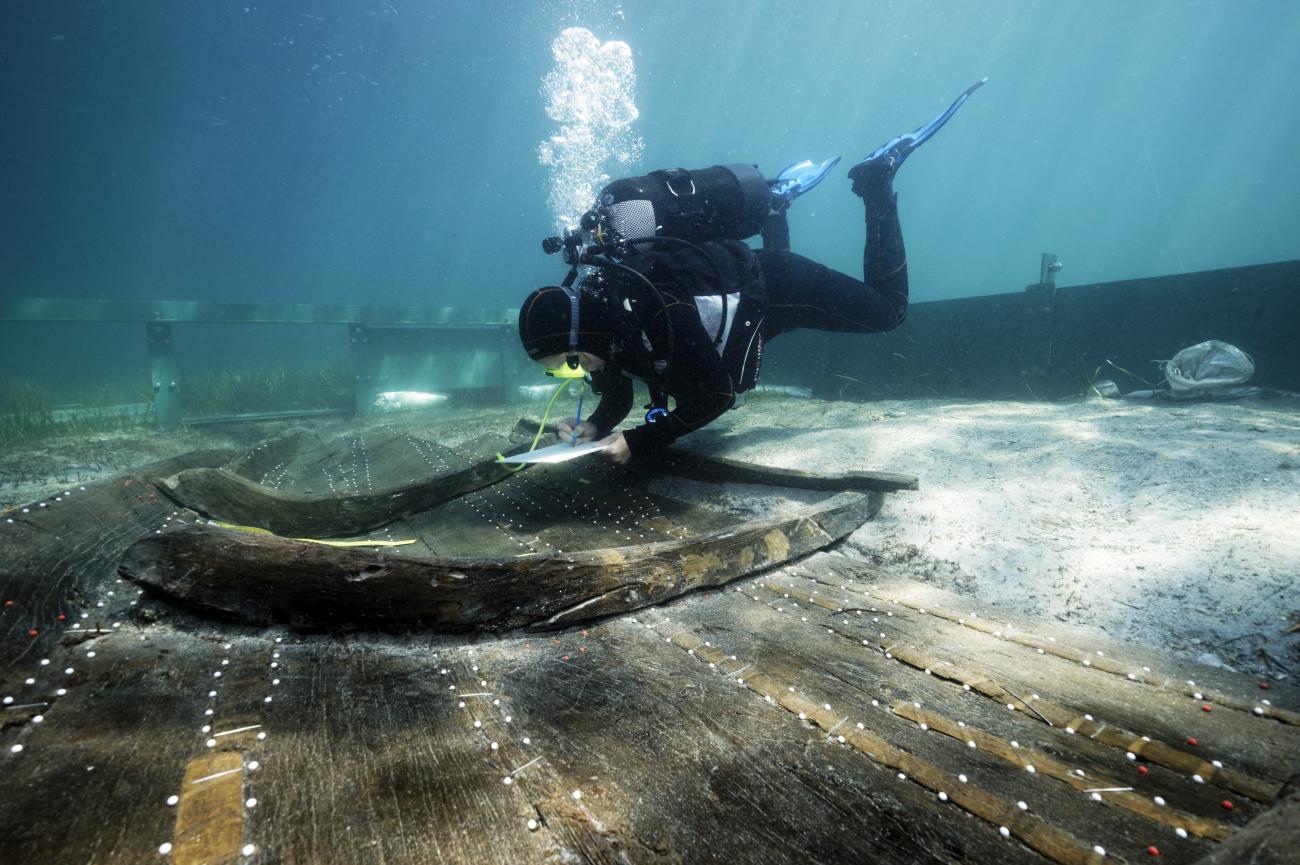
Wreck of Zambratija (Croatia) / Photo: Philippe Groscaux (CNRS - Centre Camille Jullian).
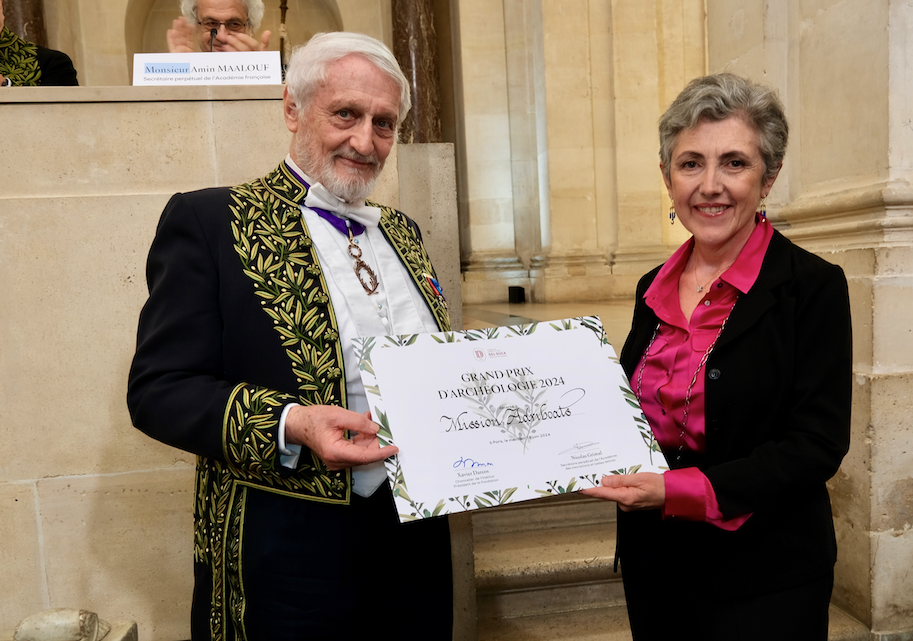
Pierre Grimal presents the Simone and Nino Del Duca Prize to Giulia Boetto, Paris, Institut de France, June 19, 2024 / Credits: Institut de France (H&K).


